Saturday, 23 March 2013

Robotic hands matching human capabilities


As part of the on-going rise of consumer-level robotics, recent research in artificial intelligence and bio-inspired devices has reached a new plateau of possibilities. Modern robots are now able to fill an increasingly broad scope of roles in both home and work environments.* Easily one of the most important (and difficult) abilities for such machines is being able to recognise and interact with various physical objects. For simple or repetitive tasks, such as assembly line production, this knowledge was relatively straightforward, requiring simple programming and mechanical systems. However, the growing complexity of environments that commercial robots now have to encounter has driven research into more intricate and capable mechanisms.
As has often been the case, engineers turned to the human body itself to model both the

Researchers develop first bionic hand with feeling


Researchers are developing the first bionic hand that can feel. It will be transplanted later this year.


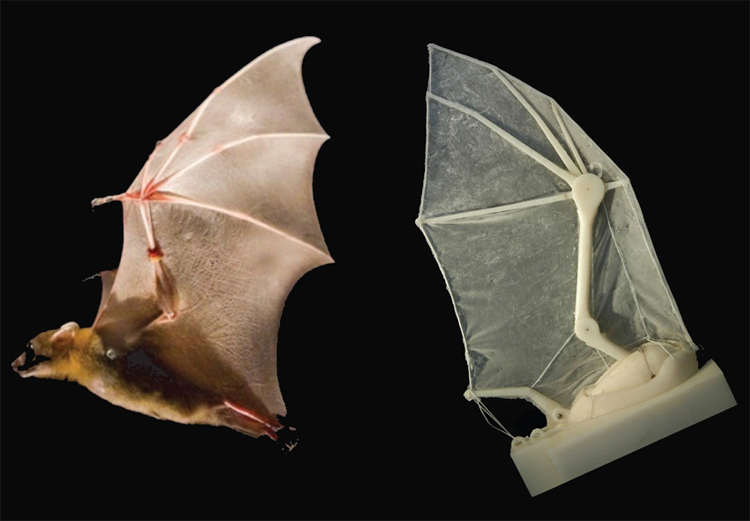
Researchers build robotic bat wing


The swift turning flight and aerodynamics of bats offers amazing possibilities for the design of small aircraft, among other applications. By building a robotic bat wing, researchers at Brown University have uncovered the flight secrets of real bats: the function of ligaments, the elasticity of skin, structural support of musculature, skeletal flexibility, upstroke and downstroke.

bat wing

Tests showed the machine can match the basic flight parameters of bats, producing enough thrust to overcome drag and enough lift to carry the weight of the model

Jetpack "anyone can fly" launched at Abu Dhabi exhibition


A jetpack costing $100,000 has been unveiled at the International Defence Exhibition and Conference (IDEX) in the United Arab Emirates. Its makers, California-based Martin Aircraft Company, say it could be used by emergency services, the military and also for leisure. The 140kg aircraft, which took 10 years to develop, can fly up to a mile high, reach a speed of 62mph and take off from a small space. It has an automated hover function, making it easy

Stretchable battery could power wearable and implantable computers


Researchers at Northwestern University have developed the first stretchable lithium-ion battery – a device that could power a new generation of flexible electronics.
The power and voltage of the stretchable battery are similar to a conventional lithium-ion battery of the same size, but the flexible battery can stretch up to 300 percent of its original size and still function. It can work for eight to nine hours before it needs recharging, which can be done wirelessly.
The potential applications are diverse and may include wearable computers, or even implantable electronics, that could monitor everything from brain waves to heart activity – succeeding where flat, rigid batteries would fail.
Professor Yonggang Huang, who led the portion of the research focused on theory, design and modeling: "We start with a lot of battery components side by side in a very small space, and connect them with tightly packed, long wavy lines. These wires provide the flexibility. When we stretch the battery, the wavy interconnecting lines unfurl, much like yarn